This morning, I received an email from Zimbra - Zimbra News: Important Zimbra Collaboration Security Updates.

One thing to note is we are not a paid customer of Zimbra, but we have been running Zimbra Community Free Edition for a long time. Yes, not a single cent for Zimbra to earn.
But, hey ... they still send us emails regarding security updates... as and when they are found over the years!
At the same time, Zimbra Collaboration 7.2.7 has been released, which fixes some security issues as well.

In the release note, there is a dedicated section on Security Fixes, where the security flaws are described and fixes/workaround are recommended.
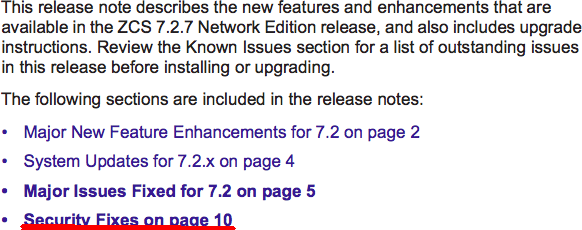
Cool, right? Still remember we are not a paid customer?
Now, we know there is a commotion lately regarding the way ForgeRock handles the latest security flaws found in OpenAM.
In late 2012 (well, when ForgeRock was still young), they published security advisory publicly to the community. It is still available in the Internet today.
The root causes and workarounds were publicly shared then.

Moving forward, when the latest security flaws are discovered, ForgeRock now decides to only briefly inform the community with the following email in the mailing list.
Dear OpenAM Community Member,
ForgeRock today issued security fixes for OpenAM releases 9.5.x, 10.0.x and 11.0.
We are sending this notice to strongly recommend that community members update their OpenAM production deployments at the earliest opportunity.
For OpenAM 11.0, fixes have been applied to trunk. If you are a customer, then you can upgrade to 11.0.1, which contains the fixes, and is available from the ForgeRock Customer Portal.
For OpenAM 9.5.x and 10.0.x deployments, contact us at http://go.forgerock.com/2014OpenAM1101SecurityAlert.html
Regards,
Security advisory is now no longer publicly available. It's now a simple one-liner: ForgeRock today issued security fixes for OpenAM releases 9.5.x, 10.0.x and 11.0.
Now, when I posted OpenAM 11.0.1 and Policy Agent 3.3.1 released!, I was of the impression that the difference between paid customers and non-paying community members is that a JAR is easily made available to the former.
If you are a paid customer and on the latest release of OpenAM, the patch is fairly simple.
1. Download the appropriate jar for your OpenAM version
2. Restart your application server
Done. As simple as that.
And I openly and still honestly think that this "convenient service" is what paid customers deserve. (Come on, there has to be a difference. Otherwise, who will pay premium service if everyone enjoy the same benefits?) On the same day, I tweeted a sentence from OpenAM mailing list - "Open Source software is NOT free. Open Source software still takes a lot of time and money in order to produce it." I was still on the same context on the "convenient service" provided by ForgeRock to paid customers.
What I did not know then (which someone later pointed out to me. Thank you very much!) was the detailed descriptions and codes that have been fixed are only made known to paid customers. The community members are expected to look at the source code trunk and to compare what has been changed. Even if the fixed codes have been found, one has to guess what exactly was the root cause to the security flaw. But all these delays will take time.
I do not agree to this. Security flaw is big issue -- to paid customers … as well as non-paying community members. Every single deployed OpenAM should be patched at the earliest time possible.
Take a look at Redhat …

Everyone single piece of information is shared publicly, including "security".

Paid Redhat customers can immediately download the latest binaries to patch their servers, while community members need to quickly see what has been changed and to apply the same into their servers.
In my opinion, paid customers should be differentiated by:
- premium, top-notch & quick turnaround support services
- product features
Security fixes should not be classified as product features. It should never be.
You see.. the point is: Yes, I may not be a paid customer now. But if your product is great and your service is excellent and you treat security as your top priority, I may well pay you for commercial support one day. Better still... for my customers, I'll definitely push your paid services to them.
Dun you get it? I thought this is Business 101?
.


