Wednesday, September 25, 2013

OpenSSO with embedded OpenDS for high-volume traffic - Part II

I managed to capture 2 graphs taken during the load-testing sessions.

With embedded OpenDS in a 12-nodes OpenSSO environment, there will be consistent spikes happening at 15-20 mins interval and subsequently 25 mins ... (that was when I issued a thread dump and realized there were numerous threads related to OpenDS replication service)


Ideally, we would prefer the following graph. Consistently flat. Spikes at 15-min and 26-mins though, but minor enough to ignore. Still trying to further tune.


PS: Getting the almost flat graph above is not totally contributed by moving the embedded OpenDS to external Sun Directory Server. There were some other tuning made. 


.

Monday, September 23, 2013

OpenSSO with embedded OpenDS for high-volume traffic

I was performing another round of performance load-testing for a customer in Singapore last week. The target was to achieve 10,000 concurrent hit per second (yes, it is a tall order) and the load must be sustained for 1 hour.

The setup was a pretty old version OpenSSO 8 Update 2 Patch 4. The embedded OpenDS was even older. It was still OpenDS 1.0.0. Why no upgrade? Well, better dun ask. Political lah.


We have, in fact, performed many rounds of tuning - OS kernel, TCP stack, Web Servers (reverse proxy), Application Servers, JVM options - prior to last week's activity.

We were almost there, except failing for 1-2 secs at times. Spikes kept coming after 15-20 mins; went away; came back again 10-15 mins later ...


So during one of the spikes, I executed a thread dump. And the following was observed:


At that point of time, we had 12 x OpenSSO servers running, with embedded OpenDS. Me bad, I know. Lazy bum me!

No choice, I made a decision to switch out from 12 x embedded OpenDS to 3 x external Sun Directory Server 7. Political again, dun ask me why you never this.. never that.. :)

Immediately, we could see the effect. The NLWP (Number of Light-Weight Processes) decreased from high-300 to mid-200 upon application servers restart. Pretty good improvement.


Subsequent load-testings also yield better result with less spikes. The NLWP never increased beyond 650 at peak (previously it could easily reached 900+).

At least, the graphs looked flatter.

We are now on our last mile... I think the reverse-proxy servers are over-loaded. Adding more hardware at the moment... Hopefully, we can achieve the expected result in a week or 2!


PS: My friends at ForgeRock also confirm that a deployment of  >4 OpenAM instances with external OpenDJ as the configuration store yields better performance. It is largely due to the meshed replication setup. Also, using the latest version of OpenDJ (2.6.0 at the moment) will help as well. OpenDS is far too old. :)


.

Saturday, September 14, 2013

Splunk SSO with OpenAM

I have just integrated SSO between OpenAM and Splunk in our intranet. I must admit this is the simplest integration I have performed so far. 


I took references from the following 2 links by Indira.

(Note: The instruction was not that clear though. A little tweaking is required. Minor though)


What really impressed me was the SSO debug page.


It was able to clearly indicate what SSO settings have been configured and what HTTP headers have been passed over from the OpenAM via the Policy Agent.


This makes debugging a breeze! Cool tool!


.


Friday, September 13, 2013

OpenAM with HOTP and OATH and Microsoft SharePoint

If Microsoft SharePoint is integrated with OpenAM, we know that the Password Replay feature is required. 


There are numerous links on how to achieve Single Sign-On between OpenAM and SharePoint server:


Another thing to note is that Authentication Chaining (e.g. AD followed by OATH) will break the Password Replay support.


This is because the password from the AD module is not carried over to OATH module. And thus the OATH module cannot pass over the password to the Password Relay Post Authentication Processing module. 

You'll get a HTTP 403: Forbidden error when trying to access a SharePoint page.

There is a workaround though. 

Step 1: Do not use Authentication Chaining

Step 2: In each HOTP and/or OATH module, set the Authentication Level to higher than 0. e.g. 10


Step 3: Create a Condition - Authentication Level in the SharePoint Policies. 


Step 4: Set the Authentication Level to 10.


Now, of course, this implies all policies have to be configured the same.


.


Thursday, September 12, 2013

OpenAM with HOTP and OATH

This week, I have a little free time of my own and am able to continue my exploration with OpenAM. I know that HOTP (HMAC-based One Time Password) and OATH (Open Authentication) features are available in OpenAM 10.1-Xpress. 


These 2 features are what customers have always been looking for, especially the financial institutions. It's great that the features are now supported out-of-the-box!

So, I went ahead to implement these new features into our existing OpenAM infrastructure.

All staff has to key in their user name and password first.


Subsequently, they will be challenged again for 2FA. 2 choices are given - HOTP which will fire an email with the OTP code; OATH where staff is to configure Goggle Authenticator on his/her mobile device.


It works like a charm!


.


Wednesday, September 11, 2013

OpenAM OATH Authentication - java.util.NoSuchElementException

There is a new authentication module in OpenAM 10.1-Xpress - OATH authentication.


And there is a nice wiki which illustrates how to integrate OATH authentication module with Google Authenticator. (Read here) That gets me interested! I could implement this for our company's intranet portal which is protected by OpenAM.


As mentioned in the wiki,

The key attributes we need to set for Google Authenticator are:
  • Auth Level.  This is a higher strength multi-factor module, so we assign a value of 10 here. 
  • One Time Password Length: This is the length of the OTP that will be displayed by the Google Authenticator application. Six is the default for Authenticator. 
  • Minimum secret key length: I used 8 for this example, which is too short for production. This is the length (in hex characters) of the encoded secret. 
  • Secret Key Attribute: This is the name of the ldap attribute where the secret key is stored. For this example I am using the "title" attribute. This isn't a great choice, and for production you would extend your ldap schema with a dedicated attribute. 
  • OATH Algorithm:  TOTP for Google Authenticator
  • Last Login Time Attribute:  The OATH TOTP module needs to store the last login timestamps (UNIX long time) in this attribute.  I am using "description" but again you should extend your schema with a dedicated attribute.

Now, one thing to take note is: besides keying in the Secret Key attribute into the LDAP server ("title" is used in the example), one has to key in a default value for Last Login Time attribute ("description").

Otherwise, you'll hit into the same error as what I had encountered:

amAuthOATH:09/11/2013 03:57:01:432 PM SGT: Thread[ajp-apr-192.168.0.89-8009-exec-10,5,main]
ERROR: OATH.checkOTP() : checkOTP process failed :
java.util.NoSuchElementException
        at java.util.HashMap$HashIterator.nextEntry(HashMap.java:796)
        at java.util.HashMap$KeyIterator.next(HashMap.java:828)
        at org.forgerock.openam.authentication.modules.oath.OATH.checkOTP(OATH.java:577)
        at org.forgerock.openam.authentication.modules.oath.OATH.process(OATH.java:322)
        at com.sun.identity.authentication.spi.AMLoginModule.wrapProcess(AMLoginModule.java:1000)
        at com.sun.identity.authentication.spi.AMLoginModule.login(AMLoginModule.java:1170)
       :
       :

This will always happen for the initial login after OATH is configured because the attribute is empty. The code could have been better written to take care of this special scenario.


.


Tuesday, September 10, 2013

Replication Gateway - Part II

I mentioned about Replication Gateway feature from OUD.


Is this the only way to replicate data from Sun Directory Server Enterprise Edition to OpenDJ or OUD?

Definitely no.


There is this free tool called LDAP Synchronization Connector.

Ldap Synchronization Connector synchronize data from any data source including databases, LDAPdirectories or files by reading, transforming and comparing these data between the source and the target referentials. These connectors can then be used to continuously synchronize a data source to a directory, for a one shot import or just to compare differences by outputting CSV or LDIF format reports.

In Azimuth Labs, we have used LSC on production sites when we migrated our customers' data from Sun Directory Server to ForgeRock OpenDJ. It works like a charm!

.

Monday, September 9, 2013

OpenAM Roadmap - Updated

The planned OpenAM 10.2 release has been dropped. Instead, OpenAM 11 will be released in this quarter.


What can one look forward to? The detail is here.

To most of my customers, the following 3 items are their top priorities:


  1. OpenAM Server IPv6 Support
  2. OpenAM Java 7 Support
  3. REST APIs Enhancements

.

Thursday, September 5, 2013

ForgeRock Business Model

This question keeps repeating the ForgeRock user forum. I think I might as well paste it here in case my customers ask me the same.


To be honest, this is fair model. The engineers also need to feed their families. We can't expect every single piece of source code be made publicly available.

.

Monday, September 2, 2013

OpenDJ 2.6.0 Control Panel

Most of the time when I deployed OpenDJ server and wanted to use OpenDJ Control Panel to connect to it, I'll run the control panel from my laptop or desktop.


And I do not usually install a OpenDJ server on my laptop/desktop because there is really no need to. So, I'll download the OpenDJ ZIP for a particular version of OpenDJ, unzip it, go to the bin or bat folder and run the control-panel executables. And I'm done!

Not with OpenDJ 2.6.0 .... there is no response when I run the control-panel executable.

After figuring it out for a while, I then realized I need to run the setup executable first. Once that's done, the control-panel will then work.


.


Thursday, August 22, 2013

ForgeRock Product release and EOSL dates

Below is a comprehensive product release and EOSL dates for ForgeRock Open Identity Stack product.


.

Thursday, August 15, 2013

Replication Gateway

I was with a consultant from South Korea this week. So he kept me updated with the technical development in Korea. 

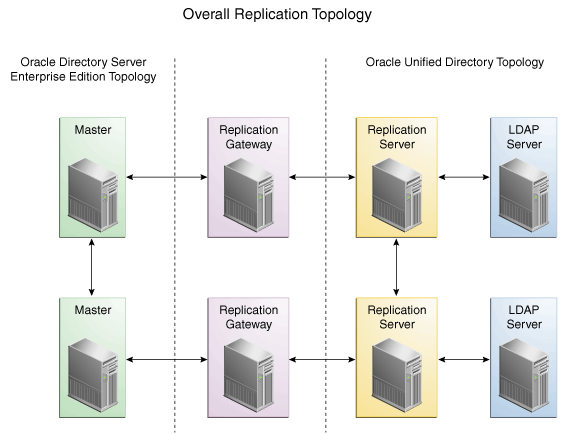
I was told that the latest hype is Oracle Unified Directory (OUD). This used to be Sun OpenDS. 

Surprisingly, he told me that OUD is able to replicate data both ways with Oracle Directory Server Edition Edition (ODSEE). This used to be Sun Directory Server Edition Edition (Sun DSEE).

As I am quite familiar with ForgeRock OpenDJ (which was also from Sun OpenDS), I know that replication both ways is not possible due to the fact that Sun DSEE replication protocol is proprietary. 


Well, but OUD and ODSEE do know each other since they are from the same family. So what if the replication protocol is proprietary? Let's make it even more proprietary! :)

So, here we go ..... let's introduce Replication Gateway! This will bridge the replication issue between ODSEE and OUD.


.


Wednesday, August 14, 2013

Policy Agent error >> find_active_login_server(): Library not initialized

Sometimes, it can be a pain looking at how the IT staff in customers' sites attempt to debug Policy Agent related issues.

Usually, what I observed is that they will keep on restarting the web containers where the Policy Agents are deployed. Then they will keep hitting the browsers and start to complain "It still cannot work! Why? Why?".


Well, if you are too lazy to take a look at the policy agent debug log, you'll never know why. Some do not even know where is the debug log located. *sigh*


2013-08-13 11:40:15.199   Error 11762:9a41700 PolicyEngine: am_policy_is_notification_enabled: InternalException in PolicyEngine::isNotificationEnabled with error message:Invalid policy handle. and code:invalid argument
2013-08-13 11:40:15.200   Error 11762:9a41700 all: find_active_login_server(): Library not initialized.
2013-08-13 11:40:19.376   Error 11762:9a417e0 PolicyEngine: am_policy_is_notification_enabled: InternalException in PolicyEngine::isNotificationEnabled with error message:Invalid policy handle. and code:invalid argument


The issue today is the Policy Agent is not able to contact OpenSSO server when the web container starts. And the IT staff never even attempt to restart the web container.

Ensure the OpenSSO server is started, then restart the web container where the Policy Agent is deploy will do the trick!


.


Tuesday, August 13, 2013

Performance Tuning

This week, I am involved in a Performance Tuning exercise for a OpenSSO infrastructure which I have  set up a few years ago.

It can be quite a learning experience for me. In fact, I find each tuning exercise to be a new experience to me, always.

This week, we have the same expert flying in from Korea to help us again. This makes the tuning exercise more fruitful. Over time, I have learnt few tips from him.

From the graph below:

1. Spikes are not good
2. Spikes are especially bad if all transactions spike at the same time


However, the above issue is easiest to solve since it implies 2 things might have gone wrong:

  • OS Kernel and/or NDD settings
  • Garage Collection in the JVM 

If the OS kernel and NDD settings are properly tuned, you'll most likely get the graph below:


Generally, most transactions should be stable (see the blue arrow). There will be occasional spikes for some transactions, which some times we can choose to ignore if the occurrence is not frequent.


After the OS kernel and NDD settings are tuned, the next step is to slowly tweak the JVM options to eliminate/lessen garage collection. 


Lesson learnt is to have a lot of patient. :)

.


Saturday, August 10, 2013

How to build OpenAM from Source

There has been numerous posting in OpenAM mailing list on how to build OpenAM from source. Repeated postings as well... I'm curious to know why it is so difficult to build OpenAM from source.

The first thing I do is to determine which version of OpenAM I want to build. This can be found from OpenAM Branches and Tags in the wiki.


Then I click on one of the hyperlink.


From there, I get the hyperlink to the SVN source. Once the source is downloaded, the final thing to do is to execute the maven command.

$ mvn -DskipTests=true -Prelease clean install


The compiled war can be found in 

$ pwd
/Users/cheechong/Documents/svn/forgerock/10.1.0-Xpress (tag)/openam/openam-server/target


$ ls
OpenAM-artifact-openam-server-10.1.0-Xpress-R6153-checksums.csv
OpenAM-artifact-openam-server-10.1.0-Xpress-R6153-checksums.xml
license
openam-server-10.1.0-Xpress
openam-server-10.1.0-Xpress.war
openam-server-10.1.0-Xpress.war.sha


That's it.


FYI, I am using Maven 3.1.0.

$ mvn -v
Apache Maven 3.1.0 (893ca28a1da9d5f51ac03827af98bb730128f9f2; 2013-06-28 10:15:32+0800)
Maven home: /usr/share/maven
Java version: 1.6.0_51, vendor: Apple Inc.
Java home: /System/Library/Java/JavaVirtualMachines/1.6.0.jdk/Contents/Home
Default locale: en_US, platform encoding: MacRoman
OS name: "mac os x", version: "10.7.5", arch: "x86_64", family: "mac"


Download the latest Maven from http://download.nextag.com/apache/maven/maven-3/3.1.0/binaries/apache-maven-3.1.0-bin.zip

Upgrade Maven to the latest

$ mvn -v
Apache Maven 3.0.3 (r1075438; 2011-03-01 01:31:09+0800)
Maven home: /usr/share/maven
Java version: 1.6.0_51, vendor: Apple Inc.
Java home: /System/Library/Java/JavaVirtualMachines/1.6.0.jdk/Contents/Home
Default locale: en_US, platform encoding: MacRoman
OS name: "mac os x", version: "10.7.5", arch: "x86_64", family: "mac"

$ cd /usr/share/
$ ls -alt maven
lrwxr-xr-x  1 root  wheel  16 Jul 22  2011 maven -> java/maven-3.0.3

$ sudo unlink maven
Password:
$ sudo ln -s /Users/cheechong/Documents/work/apache-maven-3.1.0 /usr/share/maven

$ mvn -v
Apache Maven 3.1.0 (893ca28a1da9d5f51ac03827af98bb730128f9f2; 2013-06-28 10:15:32+0800)
Maven home: /usr/share/maven
Java version: 1.6.0_51, vendor: Apple Inc.
Java home: /System/Library/Java/JavaVirtualMachines/1.6.0.jdk/Contents/Home
Default locale: en_US, platform encoding: MacRoman
OS name: "mac os x", version: "10.7.5", arch: "x86_64", family: "mac"


.


Friday, August 9, 2013

AMSFO Issue on Windows Platform

If you have installed AM Session Failover on a Windows platform, you will realize the installation and configuration are different from what you would have experienced in Linux. The behavior of AMSFO is different as well.

I just encountered this issue in customer's site - amsfo.pl script on Windows does not log output to file.


No matter how hard I tried, the log are output to the command prompt!


Looks like there'll be no fix for this issue.

.


Thursday, August 8, 2013

OpenAM Session Stickiness Concept - Part II

If you follow my previous blog on OpenAM Session Stickiness Concept, when will the MQ Cluster get into the picture?


The following is what I have lifted from OpenAM documentation. That explains all.

OpenAM gets balanced through load-balancer, where OpenAM generates a specific load balancer cookie that they can use to implement sticky balancing. If a user gets balanced to a different instance, OpenAM will first use cross-talk to that original OpenAM instance to see if the latest session information is available. If that instance doesn’t reply (because it may be down) than the OpenAM instance will fall back to its session store and see if the session information got replicated. If the information is still not there, then OpenAM will simply consider this a new request and initiate an authentication step. 


The following illustrates the flow:


(1) : User tries to access OpenAM. The load-balancer redirects him to OpenAM 1.
(2) : User will be prompted to authenticate. OpenAM 1 creates a session and stores it in CTS
(3) : The same session is persisted into the MQ Cluster via the AM Session Failover (AMSFO) component. MQ Cluster consists of a pair of Java Message Queue servers. OpenAM will only write to Java Message Queue 1 since it is configured as the Primary node.
(4) : Upon receiving the session information, Java Message Queue 1 will broadcast to Java Message Queue 2 since it is configured as the Secondary node. This ensures the same session information can be retrieved by any OpenAM instance if Java Message Queue 1 suddenly goes down.


The above architecture ensures the high-availability of user sessions in OpenAM SSO infrastructure. Nice isn't it?

.


Wednesday, August 7, 2013

OpenAM Session Stickiness Concept

When we configure a Single Sign-On infrastructure in a Production environment, we will always request that the hardware load-balancer be configured with session stickiness. Always.

Of course, the network guys will start to bombard you with "why"? I have answered the same question many times and I think it will be good to blog it here, so that I can re-use it for our next project.


Assume we have the following setup.

A very typical setup for Production - 2 OpenAM servers fronted by a hardware load-balancer; in the backend, we have a pair of Java Message Queue servers which are configured to form a MQ Cluster for the OpenAM to communicate to.


Let's zoom into OpenAM first.


OpenAM currently leverages the Core Token Services (CTS) to store the session information for its authenticated users. These sessions can remain in memory or can be persisted in the Session store. In OpenAM version prior to 10.1, the Session store refers to the MQ Cluster. (Let's ignore OpenAM 10.1 and above for this discussion)


Now, technically, because of the above architecture, OpenAM continues to function even if the load balancer is not configured with session stickiness. How?


I'll use the following diagram to illustrate how.

(1) : User tries to access OpenAM. The load-balancer redirects him to OpenAM 1.
(2) : User will be prompted to authenticate. OpenAM 1 creates a session and stores it in CTS
(3) : User tries to access OpenAM again within the same browser session. The load-balancer redirects him to OpenAM 2 instead, since session stickiness is not configured.
(4) : OpenAM 2 cannot find the user session. It will perform a "cross-talk" to the original OpenAM instance to see if the latest session information is available.
(5) : User session found in OpenAM 1!
(6) : The user will not be prompted to authenticate again.


So, it works! However, there is this penalty in (5) where the "cross-talk" takes place. The rationale of having the load balancer configured with session stickiness is to avoid this extra traffic.

And imagine there are millions of requests per hour, this extra traffic can be very taxing to the OpenAM instances. Instead of serving users with authentication and authorization, extra load is taken up for the "cross-talk" activities. This is not ideal!


.


Tuesday, August 6, 2013

Attempting to initiate broker

I blogged quite extensively on Session Failover mechanism in OpenAM. This component is definitely a must for most production deployment and it is this component which causes quite a headache at times.

Usually it's the problem with installing Java Message Queue in a hardened environment, where firewall is superbly tight. I blogged To Enable Connections Through a Firewall before and I thought it is comprehensive enough to handle all situations.

No.


The loosening of Message Queue PortMapper port and JMS port will only be applicable in a situation like the one illustrated below - Firewall is in-between a pair of OpenAM servers and the MQ Cluster where a pair of Java Message Queue reside.


Now, what if the iptables is enabled on the Java Message Queue server like the one illustrated below?


Well, the simplest thought that comes to mind will be to add the following rules into iptables:

1. Port 7777 for Message Queue PortMapper port
2. Port 17777 for JMS port 


No, it will not work. You'll observe the following warning message - Attempting to initiate a cluster connection to mq ... failed: No route to host:


I worked extensively with our network engineer and found out that there is this random port which will be established between the 2 Java Message Queue when they attempt to initiate a cluster.


Looking at the logs, you'll see the following segment:


[05/Aug/2013:14:08:12 ICT] [B1179]: Activated broker
        Address = mq://192.168.1.155:7777/?instName=ambrokerext&brokerSessionUID=4870432220830551808
        StartTime = 1375678839077
        ProtocolVersion = 410
[05/Aug/2013:14:08:12 ICT] [B1071]: Established cluster connection to broker mq://192.168.1.155:7777/?instName=ambrokerext&brokerSessionUID=4870432220830551808[/192.168.1.155:46568]


So what's the solution?

I tried setting my -D options in BROKER_OPTIONS. None will get this random port to become static.  So for the time being, we add an iptables rule to each server to allow all ports between the 2 servers.


* Sigh *

.


Monday, August 5, 2013

Porting embedded OpenDJ in OpenAM to external OpenDJ - Part III

I almost went to hell last week during a migration exercise where we moved the embedded OpenDJ servers to a pair of external OpenDJ servers in a production site for one of our customers.


In fact, I had previously verified that the migration is risk-free in our test labs. I was too confident. I forgotten the fact that there are multiple OpenAM servers deployed in customer's production environment. And thus, there are multiple embedded OpenDJ servers as well.

I tested on a standalone OpenAM with an embedded OpenDJ. Serve me right!


So, what went wrong?

In fact, as per what I have previously blog here (Part I) and here (Part II), everything worked per planned. I restarted JBoss application servers twice and the bootstrap files were updated accordingly. (The bootstrap files should be updated to point to the external OpenDJ servers, instead of the embedded ones)

Upon JBoss AS restart, I was able to see a bind message in the external OpenDJ servers. But that was it! When I log-in to the OpenAM console and navigated from tabs to tabs, the OpenDJ access logs were not moving. How could that be? I knew configuration data was stored in OpenDJ servers, and thus when the tabs were accessed, OpenAM must retrieved the appropriate information from the external OpenDJ.

And to my horror, when I debugged further, I saw that the OpenAM servers were still accessing information from the embedded OpenDJ servers. The replication between the multiple embedded OpenDJ servers was still functioning. 

I tried to add/modify some policies via the OpenAM console, and I saw that the data was written to the embedded OpenDJ servers! The external OpenDJ servers were a pair of white elephants!


The whole debugging process took a long while. In fact, we were working 1-2 hours beyond the planned schedule. 

In the end, we found the culprit to be a parameter in the Advanced tab - com.sun.identity.sm.sms_object_class_name.


By default, the value com.sun.identity.sm.ldap.SMSEmbeddedLdapObject comes pre-set in OpenAM release.

This value has to be changed to com.sun.identity.sm.ldap.SMSLdapObject in order for the multiple OpenAM servers to start communicating with the external OpenDJ servers. Not only bind access, but all types of LDAP operations.

Really stressful night. Stupid me for not testing in a multi-servers environment prior to the actual migration.


.

PS: Now, the weird thing is I still have the standalone OpenAM server running in my labs and it is able to communicate with the external OpenDJ server, even though the value com.sun.identity.sm.ldap.SMSEmbeddedLdapObject has not been modified. I also confirmed both OpenAM (our test labs and our customer's site) are running on OpenAM 10.0.0.

Why? I do not know. Strange!


.