Wednesday, April 30, 2014

OpenAM with IBM Tivoli Directory Server

We know that from OpenAM version 10.1.0 onwards, the LDAP Authentication module is able to support LDAP Behera Password Policy.


So, I was configuring the LDAP Authentication module for a customer to authentication against IBM Tivoli Directory Server. I did verified that IBM Tivoli Directory Server supports IETF-approved Password Policy (also known as Draft Behera LDAP Password Policy).

To be fair, I have no visibility to what the Customer has configured on the IBM Tivoli Directory Server. And I am not sure whether or not it has been configured properly as per documented by IBM. It's a black box to me.


But no luck! As soon as the LDAP Behera Password Policy Support is enabled, OpenAM will throw the following exceptions:

amAuthLDAP:04/14/2014 02:18:54:972 PM ICT: Thread[ajp-172.19.194.75-8009-3,5,jboss]
WARNING: unable to decode PasswordPolicyResponseControl
org.forgerock.opendj.ldap.DecodeException: Cannot decode the provided password policy response control because it does not have a value

        at org.forgerock.opendj.ldap.DecodeException.error(DecodeException.java:57)
        at org.forgerock.opendj.ldap.controls.PasswordPolicyResponseControl$1.decodeControl(PasswordPolicyResponseControl.java:114)
        at org.forgerock.opendj.ldap.controls.PasswordPolicyResponseControl$1.decodeControl(PasswordPolicyResponseControl.java:90)
        at org.forgerock.opendj.ldap.responses.AbstractResponseImpl.getControl(AbstractResponseImpl.java:119)
        at com.sun.identity.authentication.modules.ldap.LDAPAuthUtils.processControls(LDAPAuthUtils.java:1204)
     
:
:
amAuthLDAP:04/14/2014 02:18:54:972 PM ICT: Thread[ajp-172.19.194.75-8009-3,5,jboss]
No controls returned

So what this means is that use case like Password Expired cannot be automatically detected by OpenAM during authentication.

If IETF approved password policy is supported, then OpenAM should be able to detect Password Expired use case. See Password Must be Changed Now Check.

Currently, based on my testing, OpenAM is treating IBM Tivoli Directory Server as not having the Password Policy Response Control. As such, it is not able to detect Password Expired use case.

In such scenario, OpenAM will treat Password Expired use case as Invalid Credential. The output is the same as what is documented from IBM LDAP documentation.


.


Tuesday, April 29, 2014

OpenAM 11.0.1 and Policy Agent 3.3.1 released!

Last night, ForgeRock released OpenAM 11.0.1 and Policy Agent 3.3.1 at the same time!


Earlier today we released an important maintenance and security release available for OpenAM 11.0 as well as earlier versions of OpenAM 10.0.x and 9.5.x. These include fixes that address critical security issues such as Denial of Service attacks and SQL Injection attacks.  
.... 
ForgeRock strongly recommends that all customers update their OpenAM deployments with the updated security patches at the earliest opportunity. We appreciate the contribution from our customers and community members that help us to build the best, most secure product. 


If you are a paid customer and on the latest release of OpenAM, the patch is fairly simple.

  1. Download the appropriate jar for your OpenAM version
  2. Restart your application server


Done. As simple as that. (Well, this is where I feel paid customers should enjoy this convenient service from ForgeRock. Honestly.)


For Policy Agent 3.3.1, the following is the key fixes made:


You can read the Policy Agent 3.3.1 Release Note here.


Saturday, April 26, 2014

Mobile . Social Login . Single Sign-On

I was attending a webinar by CA - Enabling and Securing Multi-Channel Customer Interactions. 

Some points caught my attention:
  • replace traditional channels with mobile apps if the same customer service features were available
  • consumers prefer to use a company's mobile app for routine inquiries rather than calling the company on the phone
  • consumers have a more positive view of a company if they have a customer service app


 Social Login benefits:
  • access to large volume of social media users
  • higher level of conversion to internal prospect list
  • more targeted marketing opportunities


Now, based on the facts above, more and more decision makers will move businesses towards the Mobile and will offer Social Login.


Single Sign-On solutions in the market has to get:
  • easier to deploy (Cloud ?)
  • easier to integrate with Social Login providers
  • more secured
  • to scale even better and quicker


It's an exciting time to be in now!

.


Friday, April 25, 2014

Version file not updated after OpenAM is patched - Part II

So, according to Peter, there is a bug (See Bugster OPENAM-3280) which will impact the command line ssoadm.

I was trying out ssoadm tool yesterday and observed that the bug does not impact the setup program.

Before I patch OpenAM (which is version 10.0.0), the setup tool is able to detect the version of OpenAM correctly.


After OpenAM is patched (which is version 10.0.2), the setup tool is also able to detect the version of OpenAM correctly.


Now, once the setup is done and you start using the ssoadm command line utility, the bug will come. The command is retrieving value directly from the .version on the file-system, instead of querying directly from OpenAM Configuration Store.


By retrieving value directly from OpenAM Configuration Store, it should behave like what the OpenAM Admin Console will display.


Now, there are really some hardcode people around who insisted to use ssoadm command line utility.
(Ok, I'm just lazy. If given a choice, I'll go for UI. Using command lines doesn't make me any smarter. Ha!) Joke aside, on a more serious note, I think we are making a living trying to provide business solutions to our customers. We do not really need to insist on a certain way of doing things. If there are workarounds, go for it. Case closed, go home early and be with the family.

Back to ssoadm command line utility, before OPENAM-3280 is resolved, there is in fact a more tedious way of getting the correct version of OpenAM.

Use the export-svc-cfg sub-command. (See export-svc-cfg)

This will generate a XML file contains OpenAM Service Configuration.


Within the XML, it'll contain the current version of the OpenAM Server.

By the way, there's another bug with ssoadm. This time, it's not the command line utility issue. It's an issue with the Web UI utility (ssoadm.jsp). See Bugster OPENAM-2979 - ssoadm.jsp does not offer export-svc-cfg subcommand.


.


Tuesday, April 15, 2014

Version file not updated after OpenAM is patched

I am preparing myself for an engagement in a customer's site tomorrow to patch their OpenAM deployment from 10.0.0 to 10.0.2.


I blogged about OpenAM version 10.0.2 before. You can read it here - OpenAM 10.0.2 released!

The upgrade process is fairly easy. But of course, remember to backup, backup, and backup! You never know what will happen.


Clicking on "Save Report" will download a OpenAM Upgrade Report on the activities that the upgrade is going to take.

OpenAM Upgrade Report
=====================
Created: 20140415144314
Existing Version: OpenAM 10.0.0 (2012-April-13 10:24)
New Version: OpenAM 10.0.2 (2013-December-12 18:38)

Services Upgrade Report
-----------------------
New Services
* None
Modified Services
* sunAMAuthADService
openam-auth-ldap-heartbeat-interval
openam-auth-ldap-heartbeat-timeunit
openam-auth-ldap-operation-timeout
Added attribute openam-auth-ldap-operation-timeout
Added attribute openam-auth-ldap-heartbeat-interval
Added attribute openam-auth-ldap-heartbeat-timeunit
iplanet-am-auth-ldap-server-check
Removed attribute iplanet-am-auth-ldap-server-check
:
 
: 

New Sub Schemas
* None
Deleted Services
* None

Server Default Upgrade Report
-----------------------------
New Attributes
* attr name: com.sun.identity.authentication.multiple.tabs.used : value: false

Modified Properties
* attr name: com.iplanet.am.version
old value: OpenAM 10.0.0 (2012-April-13 10:24)
new value: OpenAM 10.0.2 (2013-December-12 18:38)


Deleted Properties
* attr name: com.sun.identity.authentication.mutiple.tabs.used

Based on the Upgrade Report above, the embedded OpenDJ which is used as the default configuration store will update a value in the LDAP attribute called "com.iplanet.am.version".

I found there is a .version text file in the file system.


Before the upgrade, the content within the .version was: OpenAM 10.0.0 (2012-April-13 10:24)

After the upgrade, nothing was changed. But everything runs fine.


Strange indeed.


.


Monday, April 14, 2014

Solaris 10 OS and Oracle Directory Server Enterprise Edition not affected by Heartbleed

We support Solaris 10 OS and Oracle Directory Server Enterprise Edition for a big customer here in Singapore. 

Both are not affected by Heartbleed security flaw.


Oracle Solaris 10 Sparc is not vulnerable to the SSL Heartbleed vulnerability.The latest patched default OpenSSL library in Solaris 10 is version 0.9.7d, which is not affected by the vulnerability. The Heartbleed vulnerability only affects OpenSSL version 1.0.1 to 1.0.1f.

Official response from Oracle Support with regard to Oracle Directory Server Enterprise Edition below:


ODSEE do not use OpenSSL. ODSEE uses NSS for the SSL libraries. You may want to refer to this link for more understanding on the topic: ODSEE 11.1.1.7.0 Administration Guide: http://docs.oracle.com/cd/E29127_01/doc.111170/e28972/ds-security.htm#bcaul


.

ForgeRock Software Not Affected by ‘Heartbleed’

Last week went kind of crazy after the Heartbleed security flaw was uncovered with customers calling to verify if their deployments are affected by the bug.

ForgeRock released a press statement on 11th April 2014.


  • ForgeRock’s products (OpenAM, OpenIDM, OpenDJ, OpenIG) do not incorporate openssl. OpenSSL is a commonly used component of open source software and Linux distributions, whereas the vast majority of ForgeRock software runs on the Java platform which uses its own TLS implementation. 
  • Some ForgeRock components use the Mozilla Foundation NSS libraries, which are also not vulnerable to Heartbleed. 

In short, ForgeRock software are not affected by Heartbleed.

.

Wednesday, April 9, 2014

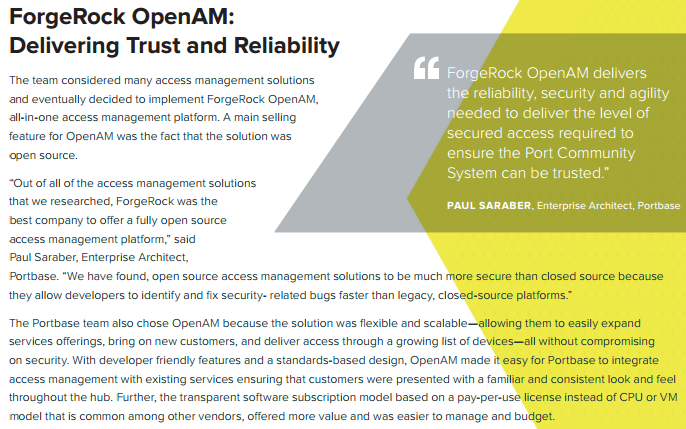
ForgeRock OpenAM: Delivering Trust and Reliability

I didn't say it. A paying customer in Holland said it.


The team considered many access management solutions and eventually decided to implement ForgeRock OpenAM, all-in-one access management platform. A main selling feature for OpenAM was the fact that the solution was open source. 
“Out of all of the access management solutions that we researched, ForgeRock was the best company to offer a fully open source access management platform,” said Paul Saraber, Enterprise Architect, Portbase. “We have found, open source access management solutions to be much more secure than closed source because they allow developers to identify and fix security- related bugs faster than legacy, closed-source platforms.”
.... 
Further, the transparent software subscription model based on a pay-per-use license instead of CPU or VM model that is common among other vendors, offered more value and was easier to manage and budget.

 .

Tuesday, April 8, 2014

OpenAM Session Failover in OpenAM 11 - Core Token Service (CTS)

So I was with a customer in Thailand last week and I talked about upgrade roadmap for OpenAM. They have OpenAM 10.0.0 currently in their production environment.

We know the OpenAM Session Failover (SFO) prior to OpenAM 10.1.0 was using the Sun Java Message Queue. Pretty complex product which makes debugging a little challenging at times (well, depending on how well trained you are). I have numerous posts in my blog talking about Sun Java Message Queue and how SFO works.


The new OpenAM roadmap since version 10.1.0 is to completely remove this cumbersome layer on the bottom and replaced it with OpenDJ. The Core Token Service (CTS) has been rewritten to use OpenDJ to store users' sessions/tokens.

Session failover also relies on a shared Core Token Service (CTS) to store user session data. The service is shared with other OpenAM servers in the same OpenAM site. When an OpenAM server goes down, other servers in the site can read user session information from the CTS, so the user with a valid session does not have to log in again. When the original OpenAM server becomes available again, it can also read session information from the CTS, and can carry on serving users with active sessions.

From operational perspective, this new feature is very much welcomed. Customers do not have to learn additional technology like Sun Java Message Queue. Instead, what they have to focus on are OpenAM and OpenDJ. And I must say both are relatively easier to pick up. Forget about Sun Java Message Queue!

Now, there is 1 thing to take note of for multi-instances deployment. One has to read carefully the documentation - CTS Deployment Scenario.


I quoted from the documentation below:

To reduce the impact of any given failure, consider the following options:
  • Start your implementation, if possible, with the CTS options available with the OpenDJ instance embedded in OpenAM. You can still set up a different backend on the embedded OpenDJ server. If the embedded OpenDJ server can handle your requirements, it will simplify implementation of CTS.
  • Isolate the user, configuration, and session stores from OpenAM in separate external OpenDJ servers.
  • Configure multiple directory stores for CTS, set up with load balancer(s).
  • Add separate servers for data store replication. For more information on how this is done with OpenDJ, see the OpenDJ documentation on Stand-alone Replication Servers.
  • Set up redundancy in the load balancer connections between OpenAM and the external data store.


A load-balancer is required in-front of the multiple external OpenDJ servers for multi-instance deployment. Why? The diagram below says it all.


There is only a single field to key in the Directory Name. The code cannot handle multiple OpenDJ in the backend. This is weird because the existing Authentication module and Data Store module are able to load-balance and failover multiple OpenDJ backends.

Unless there is a technical reason for intentionally not to support multiple OpenDJ from CTS layer. Well, I do not have the answer. I just find it a step backward with this new feature.

.


Monday, April 7, 2014

Custom OpenAM Login Page for new realm

March was full of activities for me. It was quarter-end for some customers and we were pushing hard to close as many deals as possible… right to the very last day of the quarter! Well, customers have money to spend, it's my job to help them spend wisely. :)

Of course, how can life be exciting without some running? Mid-March, I took a few days off to Hong Kong for TransLantau50 - a super challenging 50km trail race.


Once the quarter was closed, I flown off to Thailand to visit another customer. They already have OpenAM deployed a year ago and are looking to extend their SSO infrastructure to external users. With this new requirement, a new realm is recommended. They also want a totally different look-and-feel for the external users.

Can it be done easily in OpenAM? Why not?

The latest OpenAM Documentation explains it all. See To Copy the Pages to Customize For Another Realm.

In OpenAM mailing list, there are questions on why customization does not work every now and then. I think the trick is now following the instructions carefully. The technical writer said it all. I help to summarize below:

Modify appearance if you must by editing the .jsp, image, and CSS files without changing any of the JSP tags that govern how the pages work. 
Modify the localized text, using UTF-8 without escaped characters, by changing only the original text strings in the .xml files. 
If necessary, restart OpenAM or the web container to test the changes you have made.


I also like the section on How OpenAM Looks Up UI Files. It explains very clearly how the codes go about finding customized UI files.


OpenAM tries first to find the most specific file for the realm and local requested, gradually falling back on less specific alternatives, then on other locales. 
The first and most specific location as follows.
suffix_client-locale-language_client-locale-territory/services/realm/client-name/file-name


Great stuff!

.

Thursday, March 27, 2014

Cross Origin Resource Sharing (CORS) support in OpenAM

I just saw a commit for CORS support in OpenAM. I was told by Andy, Product Manager of OpenAM, that CORS will be available in OpenAM 12. 


It's a feature required by one of my customers. There are similar requests from ForgeRock's customers as well.

So.. watch out for OpenAM 12!

.

Wednesday, March 12, 2014

IRM versus IAM - 2 very different worlds!

A picture says it all.


To put it simply, IAM is all about compliance (authentication + identity management + governance) within an enterprise security parameter with a population size usually less than 50,000. In fact, a figure of >30,000 workforce with partners are not usually seen.

IRM goes beyond an enterprise and it's about the Internet of Things. It is usually sized to support a population of more than a million. It's a totally different playing ground.


That's fun! :)

.

Thursday, February 27, 2014

Policy Agent Notification

Recently, there was a discussion in OpenAM mailing list regarding Policy Agent notification which I think is worth mentioning. 

Imagine there is a cluster of application servers (for similar application, say App A) deployed behind a hardware load-balancer. 


 Of course, we need to deploy an OpenAM Policy Agent on each application server. Now, the question is: For ease of configuration, should we just create 1 x Agent in OpenAM administration console as both agents are identical?


The answer is no. Why?

See the diagram below. If agent notification is enabled and each policy agent has its own unique notification URL, then OpenAM server is able to push notification to each of them.


Now, if the 2 policy agents are "hiding behind a load-balancer" (since we only want to create 1 x Agent configuration in OpenAM administration console), the notification URL has to be set to the load-balancer FQDN.

In this case, whenever OpenAM wants to push notification, one and only one of the 2 policy agents will get notified.


This is not ideal.

.

Tuesday, February 25, 2014

OpenAM Data Store - High-Availability and Load-Balancing

It has been an interesting day trying to explain how the high-availability (failover) and load-balancing work in OpenAM for a customer.


In OpenAM administration console, the following is shown in the Data Stores tab:


This is unlike the authentication module where administrator can key in a Primary LDAP and a Secondary LDAP as shown below.


I am not able to find any useful documentation from ForgeRock at the moment. The below is an extract from old Sun OpenSSO documentation:

LDAP Server
Enter the name of the LDAP server to which OpenSSO will be connected in the format host.domain:portnumber. If more than one entry is entered, an attempt is made to connect to the first host in the list. The next entry in the list is tried only if the attempt to connect to the current host fails.   
Optionally, a server identifier and site identifier can be appended to the value of the LDAP Server attribute for redundancy. In this case, the format is host.domain:portnumber|serverID|siteID. These identifiers are assigned to the server when they are configured globally. 
  • serverID specifies a particular server as the primary LDAP server and others as secondary and tertiary (as defined) fallback servers. (If no number is specified, the LDAP server is primary.) The identifier is displayed in the OpenSSO console. 
  • siteID is not currently displayed in the OpenSSO console. It is a two digit number generated internally by OpenSSO — for example, 02. 
  
My colleague pointed me to the source code for OpenAM 10.0.0 - LDAPv3Repo.java. We dived into the getLDAPServerName() method.

private void getLDAPServerName(Map configParams) {
  :
  :
  List firstChoiceList = new ArrayList();
  List secondChoiceList = new ArrayList();
  
  // put ldapServer from list into a string seperated by space for
  // failover purposes. LDAPConnection will automatcially handle failover.
  // hostname:portnumber | severID | siteID
  // serverID is optional. if omitted, it means any(don't care).
  // siteID is optional. if omitted, it means any(don't care).
  // host whose siteID and serverID matches webtop naming's serverid and
  // siteid are put in the front of the list as well as those host which
  // did not specify a siteid/serverid because of backward compatibliity.
  // otherwise it will go to the end of the list.


Hey, good comment there inside the codes! This complement the documentation from OpenSSO.

So, I spent some time reading the codes and tracing it through with examples.


host.domain:portnumber

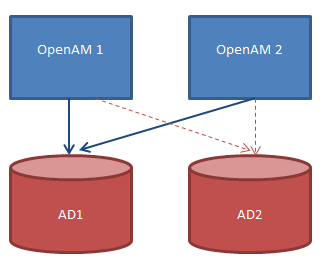
If your setting is as follows, then it only caters for High-Availability (failover/redundancy), but not load-balancing. The second AD (AD2) is always idle waiting in case of failover.


To put in simply, refer to the diagram below:


host.domain:portnumber|serverID|siteID

If your setting is as follows, then it caters for High-Availability as well as load-balancing. Both ADs (AD1 and AD2) are at work at the same time.


.


Thursday, February 20, 2014

Open Web Application Security Project - Top 10 for 2013

I came across OWASP Top 10 for 2013 and found it to be informative.


The OWASP Top 10 focuses on identifying the most serious risks for a broad array of organizations. For each of these risks, we provide generic information about likelihood and technical impact using the following simple ratings scheme, which is based on the OWASP Risk Rating Methodology.


So, here's the link to Top 10 for 2013. Quite alarming that Injection and XSS are still on top of the list year in year out.


.

Tuesday, February 11, 2014

What's the reasons to Move from OpenSSO to OpenAM?


If you still have Sun OpenSSO running and need reasons to move to OpenAM, wait no more … Sign up for the webinar - 100,000 Reasons to Move from OpenSSO to OpenAM …. Steve, with his ever in-depth knowledge of Sun Access Manager, Sun OpenSSO and ForgeRock OpenAM, will explain why!

The most important point he'll touch on is:

ForgeRock provides a very simple upgrade so that you can take your existing Oracle OpenSSO deployment -- now EOL'd with no significant updates since 2010 -- and immediately transform it into a next-generation access management platform.

.

Monday, February 10, 2014

Multi-Tenant for OpenDJ


Ludo has a great piece of advice when designing multi-tenant services for OpenDJ. Read here - OpenDJ Backends and Multi-Tenant Services.

.

Monday, January 20, 2014

OpenDJ 2.6.0 on Windows Platform

Installing OpenDJ on Windows can sometimes be clueless.

I was at a customer's site last week and was trying to showcase how easy it would be to install and setup OpenDJ and had it up and running in minutes.

I had done it countless times before the meet-up …. on Linux and Solaris …. and on my Windows 7 laptop ….  Ooops! Big mistake!

I was trying to impress, but was embarrassed.

The customer gave me a Windows Server 2008 OS. So what? I remembered Windows 2008 is supported.

But as soon as I executed setup.bat, the following error occurred:
"…\lib\winlauncher.exe is not a valid Win32 application"


A quick workaround is by setting the appropriate ClassPath and running the Java command directly.


set CLASSPATH=C:\…\opendj\lib\bootstrap.jar

java.exe -Dorg.opends.server.scriptName=setup org.opends.quicksetup.installer.SetupLauncher


That solved the setup.bat issue. But subsequently, I needed to start OpenDJ using start-ds.bat. Bomb yet again! So embarrassed.

I am now trying to reproduce the problem in our labs with a Windows 2008 R2 server and attempting to go via the pure Java command path.


Anyone encountered similar issue on Windows machine?


.